Modern Vampires
Many people in our society have fallen in love with the modern vampire myth, and many, especially our youth, have choosen to live as vamires. Vampirism is even a recognized religion by the United States federal government. A large subculture and multiple cult organizsations have arisen in which ordinary people live their lives as vampyres. Members of the subculture often prefer the spelling "vampyre" to distinguish themselves from its mythic roots. They can typically be found in underground metro-area nightclubs. The vampyre subculture is a deviant one with an obsession with and emulation of contemporary vampire lore -- fashion, music, prosthetic fangs, colored contact lenses, drinking human or animal blood, and frequenting blood bars.
~~~~~~~~~~~~~~~~~~~~~~~~~~~~~~~~
The Smoking Gun Research Agency has learned about our society's modern vampire blood rituals --
~ For modern vampires, the use of blood is what separates the dabblers from the real vampires. ~ The use of blood is commonly referred to as blood sports, blood play, blood lust and blood fetishism. ~ Blood sports encompass all forms of body mutiloation such as self-scarring play piercing in addition to cutting. ~ Blood play involves cutting the body then having another person lick or suck the blood from the cut. ~ Cutting is most often done with surgicaql scalpel or fine razor blade making shallow cuts in the top layer of the skin. ~ Occasionally blood sports entail using a syringe to draw blood and then drinking it or sharing the blood, ~ A group of people cutting or sucking each other's blood is referred to as a feeding circle. (source: http://www.sgra.org/mysteries/vampire/subculture.htm)
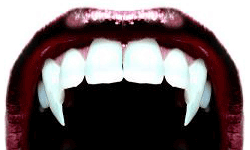 Vampire fangs. (source: www.vampyreverse.com)
One of the most recent vampirish creatures to enter modern legend is the chupacabra, which is Spanish for "goat sucker." Since the 1990's, bloody attacks on livestock in Puerto Rico, Mexico, Texas, and as far North as Maine have been attributed to the elusive chupacabra. The few alleged chupacabras killed by wary rangers have turned out to be ill, emaciated, and mange-ridden coyotes. Thus, the vampire myth continues to evolve today. |
Medical Explanations for Vampirism
Many people have attempted to explain the belief in vampires by considering medical conditions that could account for vampire-like behavior. Some of the more common conditions to have been considered are -- Porphyria - a rare hereditary blood disease. Symptoms include extreme sensitivity to sunlight, sores and scars that break open and will not heal properly, excessive hair growth, and tightening of the skin around lips and gums, which would make the incisors more prominent. Anemia - a blood disease in which the red-cell count is unusually low. The symptoms include a pale complexion, fatigue, fainting spells, shortness of breath, and digestive disorders. Catalepsy - a disorder of the nervous system that causes a loss of voluntary motion, rigidity to the muscles, and decreased sensitivity to pain and heat. Sufferers of catalepsy can see and hear, but cannot move, sometimes seeming as if they're dead. The condition could last for minutes, hours or days, causing some people to have been declared dead prematurely. (source: amarisgrey.wordpress.com)  A modern vampyre. (source: vampq.tripod.com)  Cover for Vampire's Health magazine. (source: graphics-illustrations.com) 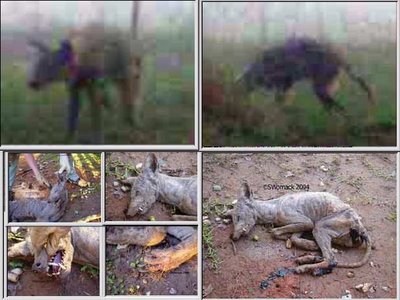 Texas Chupacabras (source: paranormalbigfoot.blogspot.com) |
